Backtest LLM trading agents without data leakage
TraderHarness treats historical contamination as an environment boundary, not a promise in a prompt.
Core controls
Point-in-time masking: every value exposed to an agent is filtered against the simulated clock. Daily bars end before the trading day, 5-minute bars stop at the current sub-window, and fundamentals must have been published by the current date.
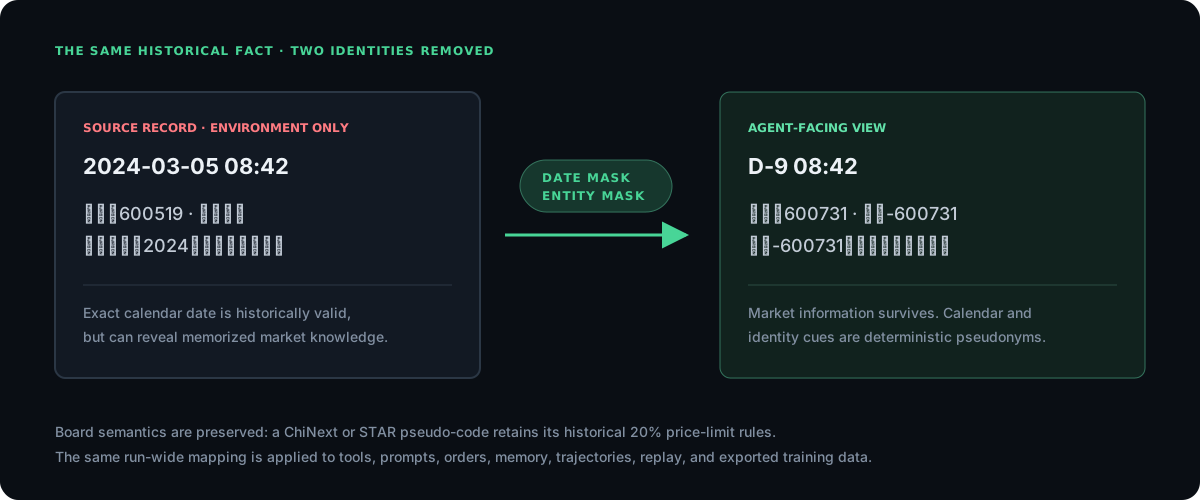
Date anonymization: absolute calendar dates become offsets relative to the simulated present. Today is D+0; the previous calendar day is D-1. Intraday times remain visible.
Entity masking: real A-share codes and known aliases are mapped through a deterministic run-wide bijection to neutral identities. Codes are shuffled inside compatible board groups so historical price-limit rules still apply.
Three-phase trading: pre-market research cannot trade; 09:30–10:00 and 14:30–15:00 windows reveal 5-minute data progressively.
Egress coverage
Masking applies to:
- daily and intraday bars;
- screening, fundamentals, valuation, announcements, and policy news;
- portfolio and watchlist views;
- DataFrames returned inside the Python sandbox;
- model responses, reasoning fields, tool arguments, and committee memos;
- cross-day memory, saved trajectories, replay cassettes, comparisons, and exports.
Agent-visible pseudocodes are resolved internally before matching. The portfolio is rendered through the same forward mapping, so an agent never needs the real code.
Artifact audit
traderharness audit result.json replay.jsonl export.parquet
The auditor checks known company aliases, six-digit A-share codes, absolute ISO and Chinese dates, and month-day forms. Passing this lexical contract does not prove that a model cannot infer a company from distinctive products, executives, financial patterns, or events. Public results should disclose masking configuration and seed and compare masked with unmasked runs when semantic re-identification matters.
Execution leakage
Information masking is meaningless if a model can inspect a complete intraday window and then choose an earlier favorable fill. TraderHarness reveals one sub-window, requests a decision, and only then considers eligible prices. Every order passes through TradingBus.place_order().